- Learning to mix colors is easier than you think: You only need a few basic colors to create a huge variety of hues.
- Color theory and the color wheel will help you create harmonious tones and avoid mistakes.
- With this color mixing guide, you'll understand step by step how primary, secondary, and muted colors work.
- Learn to mix colors at ArtNight in over 60 cities across Germany.
When you mix colors, a wide variety of hues can be created from just a few primary colors. For this to work reliably, it's important to understand how colors are structured and how they interact with each other. In this article, you'll learn the most important basics step by step, from primary colors and the color wheel to muted colors.
What produces which color? The primary colors
Primary colors form the basis of every color mixture. They are also called basic colors because you cannot mix them from other colors. Mixing colors with primary colors is the very core of painting.
In painting, these are:
- Cyan
- Yellow
- Magenta
If you mix two of these primary colors, you get secondary colors.
An important rule when mixing colors:
Equal parts of a primary color and a secondary color always result in a clear secondary color.
These mixtures form the basis for all other shades.

The color wheel: A guide for color mixing
The color wheel shows you how colors relate to each other. Mixing colors on the color wheel helps you understand:
- which colors mix well
- how to create new shades
- which colors complement or neutralize each other
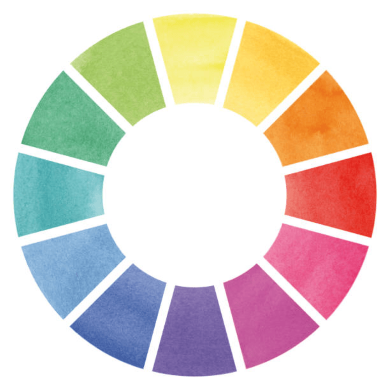
In the color wheel, the primary colors cyan, yellow, and magenta occupy three fixed positions. Between them lie the secondary colors and many other shades. Incidentally, mixing a primary color with a secondary color creates a so-called tertiary color.
Examples of mixtures in the color wheel:
- Cyan + Yellow = Green
- more yellow → results in yellow-green (even if you were to mix yellow and green directly, you would get a light yellow-green)
- more cyan → results in blue-green
- Cyan + Magenta = Violet
When we mix magenta and cyan, we get a clear violet.
- more magenta → results in reddish violet
- more cyan → results in blued violet (ultramarine)
- Magenta + Yellow = Orange
- more yellow → results in yellow-orange
- more magenta → results in red-orange
The color wheel also shows you which colors are next to each other (good for bright mixtures) and which are opposite each other (complementary colors).
How do you mix colors correctly?
When mixing colors, it's best to proceed strategically.
An important basic rule is: Always start with the weaker, lighter color.
Why? Light colors are easier to darken. If you start with a dark color, you'll need a lot of light color later to lighten the tone again.
Example: Mix light gray
Correct method:
- start with white
- add a very small amount of black → Result: controlled light gray
Unfavorable method:
- start with black
- add a lot of white → You'll waste a lot of ink.
Use complementary colors consciously
Complementary colors are colors that are opposite each other on the color wheel. They are suitable for making a color appear more muted or earthy. For example, if you were to mix red and green, you would reduce the vibrancy of both tones and create a brownish, neutral tone. However, if you mix them unintentionally, the color will quickly lose its luminosity. For vibrant colors, you should therefore only mix colors that are next to each other on the color wheel.
A sensible approach is:
- First, mix the desired shade using primary colors.
- Then, carefully add the complementary color to achieve the correct tone.
What are muted colors?
Dull colors (also called broken colors) are color tones whose luminosity has been reduced.
They have the following effects:
- calmer
- more natural
- grayer
There are two ways to dull colors:
1. With white or black
- white brightens
- black darkens and creates a grey effect, but can also make the color appear somewhat dull.
2. With the complementary color:
This is often the more natural method. For example, green can be muted with a hint of red. This looks more harmonious than darkening it with black.
Important: → always work in small quantities → cloud gradually. This technique is particularly suitable for:
- landscapes
- earth tones
- plants
- realistic painting
Which colors can you not mix?
The only colors you can't create from other colors are the primary colors:
- Cyan
- Magenta
- Yellow
All other shades are created by mixing these three colors.

Examples of typical color mixtures
Here is a handy color mixing chart (overview) for you:
- Primary colors: Cyan, Yellow, Magenta
- Secondary colors: Orange, Violet, Green
- Neutral gray: → Mixture of Burnt Umber and Ultramarine Blue
- Gray tones: → Mixture of White and Black
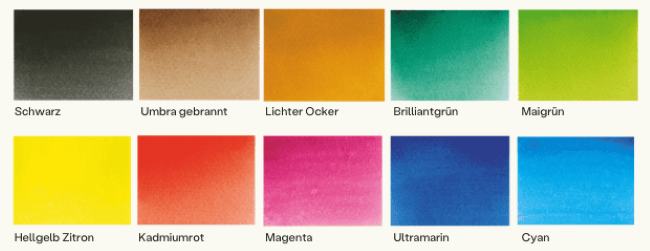
You can wonderfully apply these techniques at an ArtNight and also receive professional guidance. It's not about mixing a perfect shade, but about developing a feel for it and having fun painting.