Painting with Children - Encouraging Children's Creativity
- Can creativity be taught? Yes, creativity can be taught to children, but they should not be pushed into it.
- Ideas for creative projects with children: Painting with a cosmetic sponge, masking tape technique, or a collaborative project with shared canvases.
- Paints for children: watercolors, acrylic paints, or finger paints.
- Book a painting class for your children now at TopTeach and enjoy some creative time together.
- Discover 144 painting classes for children in Germany and Austria.
What painting techniques are there for children?
Painting with a sponge
There are numerous painting techniques that children love and that also encourage their creativity. Creative painting with children is particularly exciting when you try techniques such as applying paint with a sponge, especially a cosmetic sponge. This method is ideal for painting pictures on canvas with children, for example, to create clouds or trees.

Applying paint to a canvas
Children are often amazed at how easy it is to achieve impressive results with the right tools. Another exciting method is free painting with children, for example with a palette knife. This technique requires a little dexterity, but it is incredibly fun because colors can be layered and textures created. Painting watercolors with children or painting an acrylic picture offer further creative opportunities to create impressive works of art.
How can you encourage children's creativity?
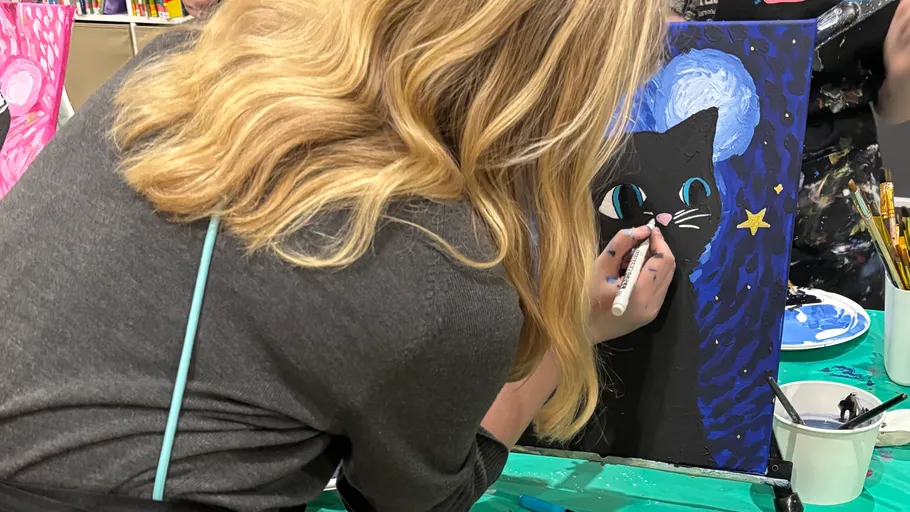
Encouraging creativity starts with trusting children and letting them make their own decisions. Especially when painting freely with children, you should praise and acknowledge their work.
Creative decisions should not be criticized, but gently guided if necessary. Painting with children is a wonderful way to encourage their imagination, and when children ask questions or seek advice, I am happy to explain techniques such as watercolor painting or acrylic painting to them. However, if they prefer to experiment, I give them the space to do so. Art with children thrives on trial and error, and even failure.
This teaches children that supposed mistakes can often lead to something completely new and beautiful if they keep going and don't give up.

Can creativity be trained?
Yes, creativity can definitely be trained and encouraged. Regular painting and creative experimentation are excellent ways to develop children's imagination and artistic thinking. The more freedom they have to try out different techniques, colors, and shapes, the more confident and creative they become in using artistic media. In the process, they often discover for themselves what they enjoy and which styles or methods particularly fascinate them.
However, there is one aspect that cannot be trained: a genuine interest in painting. Children who enjoy art will automatically engage with the subject with enthusiasm. It is therefore important not to force this enthusiasm on them. Art should always be taught in an unbiased and playful way so that children can approach painting without pressure and with curiosity.
It is particularly important that children are allowed to decide for themselves how much energy and time they want to invest in painting. Not every child will become a passionate artist, and that is perfectly fine. It's more about giving them space to discover their own interests and express their creativity in their own individual way. After all, the true value of art lies not only in the result, but in the process itself – in free expression, experimentation, and the joy of creation.
Which colors are suitable for children?
The choice of colors depends greatly on the environment and the age of the children. Finger paints and watercolors are suitable for children because they are easy to use and perfect for painting with children.
In my art classes, I often use acrylic paints because they are very versatile. Come to my painting class for children and get creative together.
Acrylic paints are easy to dilute, but can also be applied thickly for bold, color-intensive art with children. Acrylic paints are ideal for painting an acrylic picture with children because they dry quickly but can also be worked on for a long time. They offer children a great opportunity to try things out, for example when painting freely with children, and to develop their skills through creative art projects with children.

When should children start painting?
Children can start painting at a very early age, around one to two years old. At this age, the focus is on discovering colors and shapes. Painting not only promotes creativity, but also fine motor skills and concentration.
Children start painting more seriously from around second grade. At this age, they develop the patience and understanding that some pictures require a certain sequence. I consider the age of 9 to 12 to be ideal for art classes, as children of this age can make greater progress both technically and creatively.

Painting with children – ideas for creative projects
Here are some ideas for your next creative session with your children:
1. Painting with a cosmetic sponge
Materials:
- Sponge
- Acrylic or watercolor paint
- Canvas
Instructions:
Before using the sponge, dip it in water and let it soak up the liquid. Then apply your favorite paint, preferably acrylic paint, to a canvas. Here you can be completely free and make the background as colorful as you like. Once the paint is applied, you can start using the sponge: dab the paint off carefully while turning the sponge. This creates exciting effects that give your pictures a special depth. Try it out and let yourself be surprised.
2. Masking tape technique for special effects
Materials:
- Canvas or canvas board
- Masking tape
- Acrylic paint
Instructions:
Mask off any areas of the canvas with masking tape and press it down firmly so that no paint runs underneath later. Then paint the exposed areas in different colors, feel free to be creative and bold here. Once you are finished, carefully remove the masking tape before the paint is completely dry. This will prevent the paint from coming off with the tape.
You will love the result: clear lines and contrasting areas that make every picture a real eye-catcher.
3. Collaborative project with shared canvases
Materials:
- At least two canvases of the same size
- Paints
Instructions:
Place two or more canvases side by side so that they look like one large, continuous canvas. Then paint on them together as if you were creating one large picture. You can try out a variety of techniques: apply paint with a paint roller, dab the sponge over the canvases, make handprints, or even use finger paints. Once the artwork is finished, separate the canvases again. Each participant gets to take home a piece of the large work. This is a wonderful reminder of a shared creative experience.