- How do I mix paint for pouring?
- How can you find the right mixing ratio for pouring paints?
- How can you achieve layered effects with paint?
- Are there alternatives to pouring medium?
- Are all acrylic paints suitable for pouring?
- What are the best acrylic paints for pouring?


- For acrylic pouring, the ideal mixing ratio between pouring paint and pouring medium is 1:1.
- Experiment with different ratios, consistencies, and pigment densities to find the ideal mixing ratio for acrylic pouring.
- Pouring medium alternatives include Floetrol and vinyl glue, which are particularly well-suited for thinning acrylic paints.
- Any acrylic paint can be used as a pouring paint if it is made fluid with a medium.
Making your own pouring paints allows you to create your own mixtures and have creative control over flow and color combinations when doing acrylic pouring. Find out what supplies you need to achieve the best acrylic paints for pouring.
How do I mix paint for pouring?
A good acrylic pouring mixture is relatively easy to make. First, dilute the acrylic paint with the pouring medium. You can mix the medium with the paint in a ratio of about 1:1, meaning 50 percent paint and 50 percent pouring medium. If the acrylic pouring mixture is still too thick, you can also add a small amount of water. If a liquid, flowing pouring paint has formed after mixing, you can assume that the correct consistency for acrylic pouring has been achieved.

How can you find the right mixing ratio for pouring paints?
When searching for the ideal mixing ratio for pouring paints, there are several factors to consider in order to achieve an impressive result. Here are some tips to help you find the right mixing ratio and optimize your pouring artworks:
- Experiment with different ratios: Start with small amounts of paint and mix them in different ratios. Note down the amounts used so you can compare the results. Through these experiments, you can find the optimal mixing ratio for your desired consistency and color effect.
- Consider the consistency: The mixing ratio affects the consistency of the pouring paints. If you want to achieve thicker pools or marbling effects, you should use more acrylic paint. If, on the other hand, you prefer thinner layers and more fluid effects, you should use less paint.
- Consider the pigment density: Different paints have different pigment densities. Some paints may require less paint to achieve an intense color effect, while others may require more. It’s important to take this into account when mixing the paints to achieve the desired color result.
- Test on different surfaces: Different surfaces can yield different results. Try out different substrates, such as canvas, wood, or ceramic tiles, to see how the mixing ratio affects the final result.
- Document your results: Keep track of your experiments and results. This will help you monitor your progress and optimize your mixing ratios for future acrylic paintings.
By following these tips and experimenting continuously, you can find the right mixing ratio for pouring paints and take your pouring art to the next level. Remember that it’s also a matter of personal preference and there are no hard and fast rules. Let your creativity run wild and have fun discovering the optimal mixing ratios for your unique works of art.
How can you achieve layered effects with paint?
In most cases, you can apply multiple layers at any time, as this is one of the unique properties of acrylic paints. When pouring, you should pay a bit more attention to the layering due to the liquid state of the paint and, if necessary, let the paint dry slightly before each layer.
However, there are also various steps and techniques for achieving impressive layered effects with acrylic pouring:
- Mix your pouring paints in advance: Prepare your acrylic paints by mixing them with pouring medium and, if necessary, water to achieve a fluid, pourable consistency. Make sure to prepare different acrylic paints for pouring that harmonize well with each other.
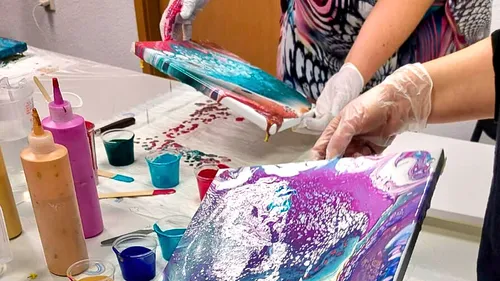
- Pour the base color: Pour a layer of your acrylic paint onto the canvas or surface. Spread the paint evenly by tilting the canvas slightly or using a brush. This forms the first layer and serves as the background for the subsequent layers.
- Pour additional colors over it: Now carefully pour additional pouring acrylic paints over the base color. You can pour the paints directly or use various techniques such as pouring in a thin stream or using a cup with multiple spouts. Pour the paints in serpentine lines, circles, or other patterns to create interesting layers.
- Use the tilt or swipe technique: To enhance and blend the color layers, you can use different techniques. With the tilt technique, you carefully tilt the canvas in different directions to move the paints and create layers. With the swipe technique, you also use tools. To do this, you can gently drag a card or a palette knife across the paints to blend them together and create interesting patterns.
- Experiment with different viscosities: By altering the viscosity of the pouring paints, you can achieve different effects. Use thicker paints for clearly defined layers and thinner paints for smooth transitions and blends.
- Let the layers dry: Allow your pouring artwork to dry thoroughly to set the layers of paint. Depending on the environment and the thickness of the layers, this can take anywhere from a few hours to several days. Make sure the piece is completely dry before touching or sealing it.
By following these tips and experimenting with different paints, pouring techniques, and viscosities, you can achieve various textures through fascinating layers of color in acrylic pouring.

Are there alternatives to pouring medium?
In acrylic pouring, the pouring medium is used to thin the acrylic paints, improve their flow, and reduce the formation of cracks. Pouring mediums for acrylic pouring techniques come in various grades. Depending on the product, this can be quite expensive.
Floetrol Pouring Medium
Floetrol is actually not a traditional acrylic pouring medium. However, it is a well-known pouring medium frequently used in acrylic pouring art. It is a specially developed additive that improves the flow of acrylic paints and reduces the formation of cracks. Floetrol is often used as a pouring medium because it thins the paints without significantly affecting their pigment concentration.
Vinyl Glue
A cost-effective alternative is vinyl glue. To use vinyl glue as a pouring medium, mix it with acrylic paints in a ratio of about one part paint to one part glue. Distilled water can then be added to adjust the consistency and achieve the desired flow. The mixture should be stirred thoroughly to ensure a homogeneous blend. It is important to note that vinyl glue may not offer the same quality as specialized pouring mediums.
Are all acrylic paints suitable for pouring?
There are no restrictions on paint types. You can actually use any acrylic paint to achieve optimal results . The key with every application is to ensure the paint is made fluid with a medium both before and during application.
Tip: Learn all the tips and tricks for pouring paints in one of our acrylic pouring classes at the Makeup Artistry School and create your own unique piece using acrylic pouring paints.

What are the best acrylic paints for pouring?
For optimal color effects, you can use any of your favorite colors. White acrylic paint creates exciting effects in the painting and is therefore highly recommended.