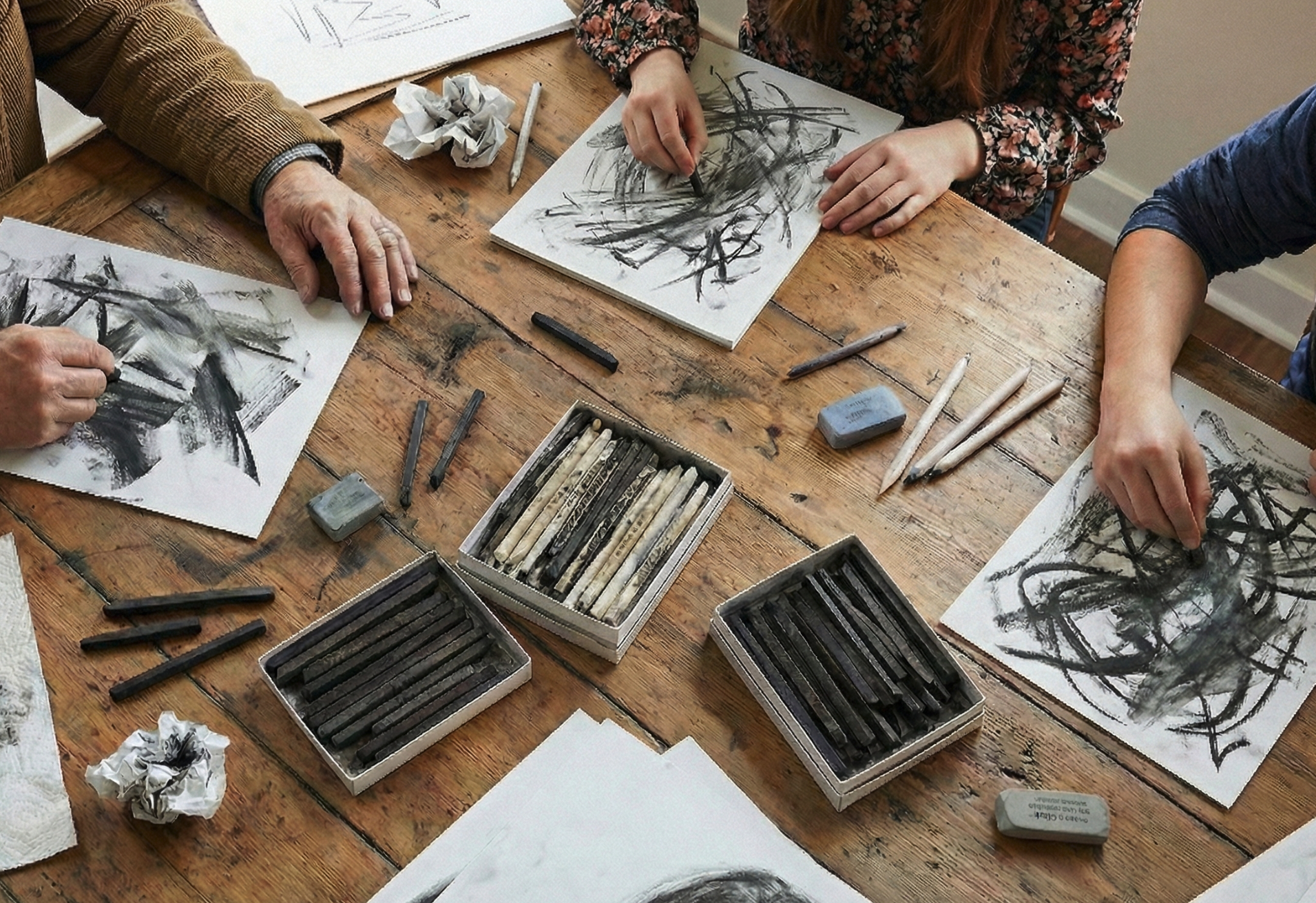
- Charcoal drawing is an expressive experience: You work directly with the material, smudge contrasts, and focus entirely on the interplay of light and shadow.
- Paper beats canvas: Start with light tones on paper, begin with abstract shapes, and above all, enjoy your creative process.
- Create your own charcoal drawing: Visit creeativ in Hamburg and create your own charcoal artwork in the charcoal drawing workshop.
- Discover 299 drawing classes to try charcoal drawing live, or give a creative class gift card.
Light and Dark - Your Guide to Charcoal Drawing:
I've always spent a lot of time composing music, playing concerts, and programming games on screen. But three years ago, during a month-long retreat in Finland, I discovered something completely new: charcoal drawing. It felt like a real fresh start.

I'm thrilled to share this process with you, because charcoal art completely changed how I see creating. Even though I don't consider myself a classically trained artist and have no formal training, I want to show you how wonderfully you can draw with charcoal. Let me walk you through my process.
What Is Charcoal Drawing?
For me, charcoal drawing is less a standard drawing tool and more of a physical experience. You literally take a piece of burnt wood and drag it across a page. When you use charcoal for drawing, you quickly notice: it's a wonderfully "messy" medium that demands to be smudged, rubbed, and blended.
You can push the medium all the way to photorealism if you want. Personally, though, I prefer expressive, evocative art. Your mind fills in the missing details with its own imagination. Because the medium is so incredibly expressive, when drawing with charcoal you can focus entirely on the dramatic contrast between light and shadow, and on the movement of your hand.

What Do You Need for Charcoal Drawings?
When I started out and wanted to make my first charcoal drawings, I bought a simple starter kit. It might not be top-of-the-line quality, but it's a single purchase, and you immediately have all the basic tools on hand. Most kits include the following:

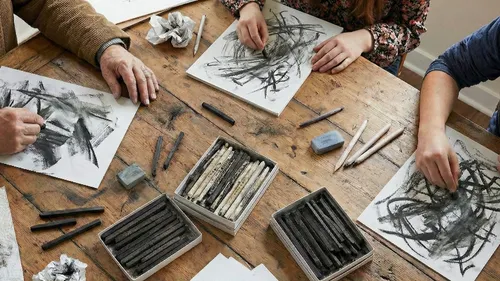
- Willow charcoal or vine charcoal: These are literally just charred twigs. They're super lightweight. The marks they make are soft and very easy to wipe away again. I use them for your first sketches.
- Compressed charcoal & charcoal pencils for drawing: This is the dark, heavy material. Charcoal dust is pressed with a binder into a pencil or block shape. I reach for this when I need deep, rich, bold shadows.
- Kneaded eraser: This is a soft, moldable eraser that feels a bit like modeling clay. Instead of rubbing it across the paper, you press it onto the surface to gently lift off the charcoal dust.
- Textured (toothy) paper: Since charcoal is basically just loose dust, it needs a rough surface to cling to. I really like cream-colored paper, or at least something that isn't too glossy or white.
- Fixative spray: After a while, you should get a fixative spray. Once you've finished a charcoal drawing, you apply this clear spray at the very end. This seals the charcoal dust so your artwork doesn't smudge.
Is Charcoal Better Suited to Canvas or Paper?
When I started, I was advised to use paper. Naturally, I still tried drawing on canvas. I quickly realized why that doesn't work well.
The woven texture of a standard canvas is much harder for beginners to handle, and the charcoal often doesn't adhere properly. Paper is simply much easier to master when you're getting started with the medium. It's also significantly cheaper.

Is Charcoal Drawing Hard to Learn?
That depends on what you mean by "learn." For me, art is a never-ending journey. Especially when it comes to charcoal drawing for beginners, you'll need at least a few attempts to really get comfortable with the medium.
Here are my tips for your first attempts:
- Start light: Since it's basically all about working with light and shadow, you shouldn't go overboard with your tonal values at the start. It's much easier to begin with a light gray and darken it than the other way around.
- Respect the eraser: The kneaded eraser is a powerful tool. But it can't work miracles once you've pressed pure, deep black into the paper!
- Watch out for smudging: Charcoal is extremely sensitive. Literally the slightest smudge can ruin your work, especially if you accidentally brush the back of your hand across the paper.
What Should You Draw?
If you'd like to get started making your own charcoal drawings, it's best to follow these steps:
- Start abstract: Get used to the physical properties of the medium. Smudge, press, and feel how the charcoal responds.
- Move to shapes: Once you feel comfortable, you can move on to basic shapes. After that, maybe try simple landscapes, still lifes, and faces.
- Practicing vs. having fun: Always remember that "practicing" is one thing and "having fun" is another. Don't forget to try drawing something you genuinely like, even if you know full well it won't turn out perfectly right away. Just do it for fun, that's a huge part of the joy.