Constellations and personal encounters after iOPT in Frankfurt


Request a private event
Request specific dates for this event. Also for company events and private groups. Get a non-binding quote.
About this class
The IOPT self-encounter method was developed by Prof. Dr. Franz Ruppert (professor of psychology and licensed psychological psychotherapist).
It has its origins in constellation work, but is fundamentally different from classic family or system constellations. The focus is not on the outer system, but on the inner psychological structure of the human being — in particular the effects of early attachment and relationship experiences on identity, perception and behavior.
Basic assumptions of IOpt
The IOpT assumes that the psyche is divided into different parts as a result of traumatic experiences:
➤ Healthy parts represent the ability to perceive, feel and act consciously in the here and now. This results in orientation, liveliness, connectedness and self-regulation.
➤ However, survival shares that arose as a protective reaction to traumatic experiences and served psychological survival often lead to internal conflicts and restrictions.
➤ Injured parts that carry the original traumatic experience and are associated with pain, fear or powerlessness become accessible through conscious perception.
What happens in an IOpt position/ self-encounter?
In a self-encounter after iOPT, these parts can become visible. For this purpose, a portion of the psyche in the room is set up by resonance generators that act together.
This can reveal internal connections that often unconsciously shape how we feel, think and act.
What has so far seemed confusing, contradictory or stuck (injured/traumatized parts or survival shares) can be identified in a larger internal context.
This form of self-perception creates clarity and strengthens healthy parts. Strengthening healthy shares results in a more conscious, coherent approach to yourself and your own decisions.
In which areas of life can an IOPT self-encounter be relevant?
A self-encounter after iOPT can relate to different areas of life, depending on personal concerns. This includes relationship issues, professional issues, handling money, and internal conflicts or blockages.
In each case, the focus is on the perception of the inner parts and dynamics that shape one's own experience and action in these areas.
How does a self-encounter work?
➤ You bring in your personal concerns, such as a recurring relationship pattern or topics such as self-confidence, money, security or career.
➤ You express your concern in one sentence (usually positive, as a goal to be achieved), such as “I want to be loved” or
“I want security.” Alternatively, choose three relevant words for your concern, such as “I — relationship — dispute” or “I — pattern — relationship.”
➤ Representatives are then elected from the group who represent individual elements of the sentence or the chosen words and represent inner psychological parts.
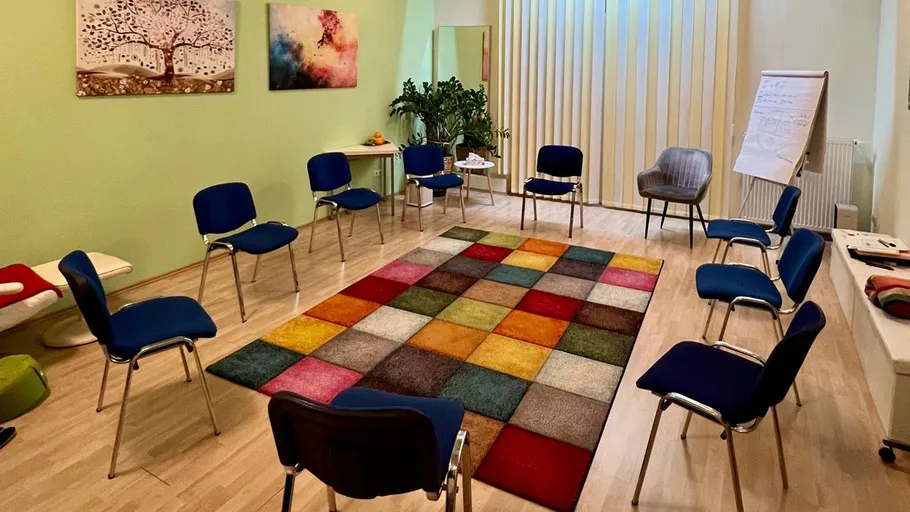
➤ These take up their position in space. It is perceived how they are standing, how they feel and what is shown internally. Sensations, body reactions, movement impulses, thoughts or emotions can arise.
➤ The dynamics between you and the representatives reveal how the inner parts relate to each other.
➤ The support provides a secure framework and supports contact with the internal components throughout the process.
➤ What emerges can enable a deeper understanding of one's own inner dynamics. Newly gained clarity can open up new perspectives and options for action.
What can this actually do for me?
A line-up can help
- to understand yourself and your concern/topic better
- to perceive reactions and patterns more consciously
- To recognize connections that were previously only diffusely perceptible.
Many people experience afterwards
- more inner clarity or orientation,
- more distance from stressful patterns,
- and a deeper understanding of yourself.
Love & relationship patterns — what can be seen in relationships
In IOPT self-encounters, recurring relationship patterns, attachment dynamics and typical conflicts can become more visible. Emotions, inner convictions and old influences that influence relationships can be perceived more consciously. This can contribute to greater clarity and help to understand why certain relationships or situations in relationships are similar over and over again.
Common relationship topics/concerns that people come up with
- Recurring relationship patterns
- Engagement and partner choice dynamics
- Proximity, distance and demarcation
- Set self-worth and limits
- fear of loss or fear of closeness
- Losing yourself in relationships
- Difficulty building trust
- Strong emotional responses in conflicts
- Dependence or over-adjustment in relationships
- Unfulfilled partnerships
- The feeling of not really being loved or seen
- Withdrawal or emotional distance
- Jealousy or control issues
- Difficulty expressing needs
- Afraid of being abandoned
- feelings of guilt or shame in relationships
- Assumption of roles (e.g. rescuer)
- Relationship conflicts without a clear trigger
- Recurring misunderstandings
- Communication issues
- Sense of loneliness despite a relationship
- Loyalty conflicts (e.g. family vs. partnership)
- Old relationship experiences that are still effective today
- Difficulty ending relationships
- The feeling of always being too much or too little
important
All installations take place in a protected, confidential setting. Personal information must not be shared with the outside world!
Options for the day seminar
Option 1 — Personal Encounter/Line-up (99 EUR)
- Introduction to the method and preparation for your own concerns
- A complete personal self-encounter after iOPT (approx. 60—90 minutes)
- Accompaniment by Maria Ravariu or Dieter Jakob (optional)
- Participation in the entire workshop day
- Space for integration, exchange and reflection
Recommended for anyone who wants to explore their own concerns or topics as part of a self-encounter following iOPT.
The focus is on identifying inner parts and unconscious dynamics that influence love relationships and interpersonal relationships.
Option 2 — Participation as a substitute (29 EUR)
- Introduction to the IOpt self-encounter method
- Participation in the entire workshop day (approx. 8-9 hours)
- Involvement as a representative in the self-encounters of others
- Opportunity to better understand set-up processes and dynamics through observation
- Every participation opens up new perspectives — even as a representative, you can go out of the day deeply touched and moved from within
Ideal for anyone who wants to get to know IOpt or loves IOpt, knows the added value of the proxy role and wants to contribute.
Even without personal concern, participation can deeply touch, trigger internal processes and open up new connections and perspectives on one's own life.
The attendants
The IOPT constellations are led by Maria Ravariu and Dieter Jakob. Both received further education in IOpT (identity-oriented psychotrauma theory) directly from Franz Ruppert in Munich. Both will be with you in your line-up.
Maria Ravariu has a bachelor's degree in psychology, an ICF (International Coaching Federation) certified coaching training and IOpT (identity-oriented psychotrauma theory) training with Franz Ruppert in Munich. She works independently as a psychological counselor, ICF life coach and iOPT companion online and in Frankfurt. In addition to her practice, she is also active online, is passionately involved in various projects, promotes reflection and authentic encounters and organizes regular, free spaces for personal exchange and growth.
Dieter Jakob is a coach, mentor and curator at the Abenteuer Mensch Foundation, which is committed to human growth and emotional well-being. He also has an IOPT training course based on Franz Ruppert and has been working intensively on psychology and personal development for over 10 years. He also works professionally as a sales manager and is also involved online, with challenges, courses and regular personal development meetings.
What you’ll do in the class
3 self-treatments are carried out in one day. These run as follows:
➤ You bring in your personal concerns, such as a recurring relationship pattern or topics such as self-confidence, money, security or career.
➤ You express your concern in one sentence (usually positive, as a goal to be achieved), such as “I want to be loved” or
“I want security.” Alternatively, choose three relevant words for your concern, such as “I — relationship — dispute” or “I — pattern — relationship.”
➤ Representatives are then elected from the group who represent individual elements of the sentence or the chosen words and represent inner psychological parts.
➤ These take up their position in space. It is perceived how they are standing, how they feel and what is shown internally. Sensations, body reactions, movement impulses, thoughts or emotions can arise.
➤ The dynamics between you and the representatives reveal how the inner parts relate to each other.
➤ The support provides a secure framework and supports contact with the internal components throughout the process.
➤ What emerges can enable a deeper understanding of one's own inner dynamics. Newly gained clarity can open up new perspectives and options for action.
Who is the class suitable for?
- Singles and single people who are open for a relationship
- People who always end up with the wrong people
- People whose relationship starts off happy but ends in chaos
- People who are interested in men/ women who are not available
- People who don't feel lovable
- Anyone interested in the topic of “relationships and ability to relate”
- People who are open to personal development
- People who want to heal old relationship pain and get ready for new, loving connections
- People who are (still) looking for the right relationship and want to find out how they can attract and make it last
Details to remember

Dieter Jakob - Life Coach
Maria (graduate psychologist) and I have been living a conscious relationship for 6 years. For us, therapy & reflection are the keys to personal growth. Our findings flow into retreats & workshops on self-development & healthy relationships.