- Learning to embroider is easy – with a few basic stitches like the backstitch or French knot, you can get started right away.
- You only need a little material – fabric, thread, a needle, a hoop, a needle threader, and scissors are enough to start.
- There are many embroidery stitches – like the running stitch, chain stitch, satin stitch, or lazy daisy stitch.
- Great beginner projects – flowers, names, zodiac signs, or simple patterns.
- Learn embroidery live in a class – in my zodiac sign embroidery class in Leipzig, I'll show you everything step by step.
Embroidery is fully back in style, and rightfully so: it's relaxing, sparks creativity, and lets you create beautiful one-of-a-kind pieces. Whether you want to decorate fabric, create small works of art, or simply unwind, learning to embroider is easier than you think.
What Exactly Is Embroidery?
With embroidery, you create symbols, patterns, and motifs from a series of connected stitches. Embroidery is a bit like "painting with a needle," and it's wonderfully relaxing for everyday life.
The various embroidery techniques consist of flat stitches, knots, or small loops that you can apply to fabric, paper, and more.
The origins of embroidery likely trace back over 3,000 years to China, where dragons, tigers, and especially birds were popular motifs. Egypt also had a rich embroidery tradition, favoring geometric symbols. It's been a long road to modern embroidery, which now works with countless shapes and colors. In embroidery, nothing is impossible, and there's no right or wrong. From clothing to tablecloths to decorative pieces, embroidery adds beauty to all kinds of things.
What Do You Need for Embroidery?

If you want to learn embroidery, you don't need much at all. Here's a quick overview:
Fabric
You can embroider on almost any fabric. I personally like using slightly coarser cotton or linen fabric.
Embroidery Thread
For embroidery, you'll need special thread, like embroidery floss. It's made up of several fine strands that you can easily separate if you want to work with more delicate detail.
There are also many other types of thread, depending on what you're planning:
– Matte embroidery thread for a more subdued, matte finish – Pearl cotton, which has extra sheen and is a bit thicker – Wool embroidery yarn for coarser fabrics or a rustic look – Quilting thread for hand quilting – Novelty threads with glitter, metallic finish, or color gradients for that special touch
And that's far from everything, this is where you can really get creative.
Embroidery Needle
Choosing the right needle makes a big difference in embroidery:
For coarser fabrics like linen, a blunt embroidery needle usually works well, since it glides easily between the woven threads without damaging them.
For finely woven fabrics, though, you should use a sharp needle so you can work with precision.
It's also important that the needle size matches your thread, which makes threading easier. The eye of the needle needs to be big enough for the thread to pass through easily, but not so big that it leaves unsightly holes in the fabric.
Embroidery Hoop
Embroidering with a hoop is much more relaxing than working freehand. The hoop keeps your fabric nicely taut, so you can stitch more evenly and precisely.
Think of it like a drum: the skin needs to be stretched tight for the sound to come out clean. In the same way, the embroidery hoop provides the right tension, resulting in a beautiful finished piece.
Needle Threader
If you want to skip the fumbling that comes with threading a needle, definitely get yourself a needle threader. It gets the thread through the eye of the needle in no time, without any frustration. Especially handy if you switch colors often or work with fine thread. Fast, simple, and stress-free.
Scissors and a Fine-Tip Pen or Pencil
What else do you need? A good pair of fabric scissors to cleanly cut your thread and fabric, and a fine-tip pen or pencil to sketch your design onto the fabric beforehand. With that, you'll have everything you need for embroidery.


What Stitches Are There in Embroidery?
You don't need a huge collection of techniques to get started, a handful of basic stitches is more than enough to create beautiful results.
The best part: it doesn't need to be perfectly precise. Small irregularities are often what give your work its charm and character. So don't be afraid of your first stitch, just dive in and experiment!
Once you've practiced the basic stitches a few times, it starts to feel almost automatic. And with practice comes inspiration too. Promise.
Backstitch – One of the Simplest Embroidery Stitches
The backstitch is great for clean lines, outlines, or lettering. It's really easy to learn.
Backstitch – How to Do It:
- 1. Bring the needle up through the fabric a few millimeters ahead of the starting point of your line, going from below to above.

- 2. Then push it back down through the fabric exactly at the starting point.

- 3. Now for the next step: bring the needle up again, a little further ahead on the line.
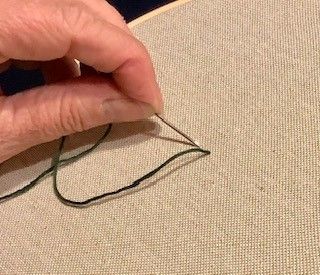
- 4. Then stitch back down again, into the last exit hole.

So with each stitch, you "step" forward and "come back" with the needle, hence the name.

Keep going until your line is complete.
Finally, secure the thread on the back with a few small stitches or a knot.

Ideal for: lettering, outlines, and anything that needs a clean edge.
French Knot – One of the Prettiest Embroidery Stitches
The French knot is perfect when you want to add small accents, like flower centers, eyes, or decorative dots.
French Knot – How to Do It:
- Bring the needle up through the fabric from below.
- Hold the thread lightly taut with your free hand.

- Wrap the thread around the needle three times, loosely but with control.

- Now bring the needle back down through the fabric very close to the original entry point.
- Keep the thread lightly taut the whole time, this keeps the knot in place.

This creates the little knot.

The knot gets bigger or smaller depending on how many times you wrap the thread. Ideal for: details, flowers, and playful patterns.
What Other Stitches Are There?
Besides the backstitch and French knot, there are many other beautiful stitches you can use to get creative with your embroidery. Here's a quick overview:
- Running stitch: The simplest stitch of all, perfect for fine lines, patterns, or fill work.
- Chain stitch: Looks like a small chain, ideal for curved lines or decorative accents.
- Satin stitch: Lets you fill in areas completely, great for leaves, flowers, or lettering.
- Stem stitch: Perfect for curved lines, stems, or lettering, has a slightly twisted look.
- Lazy daisy stitch: A classic for flowers, resembles individual petals.
- Fishbone stitch: Looks like a herringbone pattern, lovely for leaves or decorative borders.
- Bullion rose stitch: Looks like a tiny rose.
- Straight stitch: A line of small, even stitches.
And that's far from everything, there are so many more wonderful stitches to discover. But don't worry, you don't need to learn them all at once.
Just pick a few favorite stitches and get started. Over time, you'll grow more confident, try new things, and your collection will naturally expand.
Is Embroidery Easy to Learn?
Definitely yes, embroidery is easy to learn. With just the basic stitches, you can already tackle plenty of beautiful embroidery projects. As a beginner, just don't take on too much at once. Start with a few basic stitches before moving on to more complex projects. The important thing is to simply get started, and practice will do the rest. The great thing about embroidery is that you can always undo the thread if you make a mistake. And it's so wonderfully portable, you can take your project with you anywhere.
What Can I Embroider as a Beginner? (Ideas for Motifs, etc.)
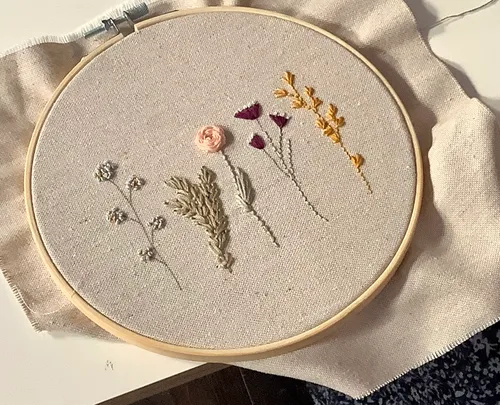
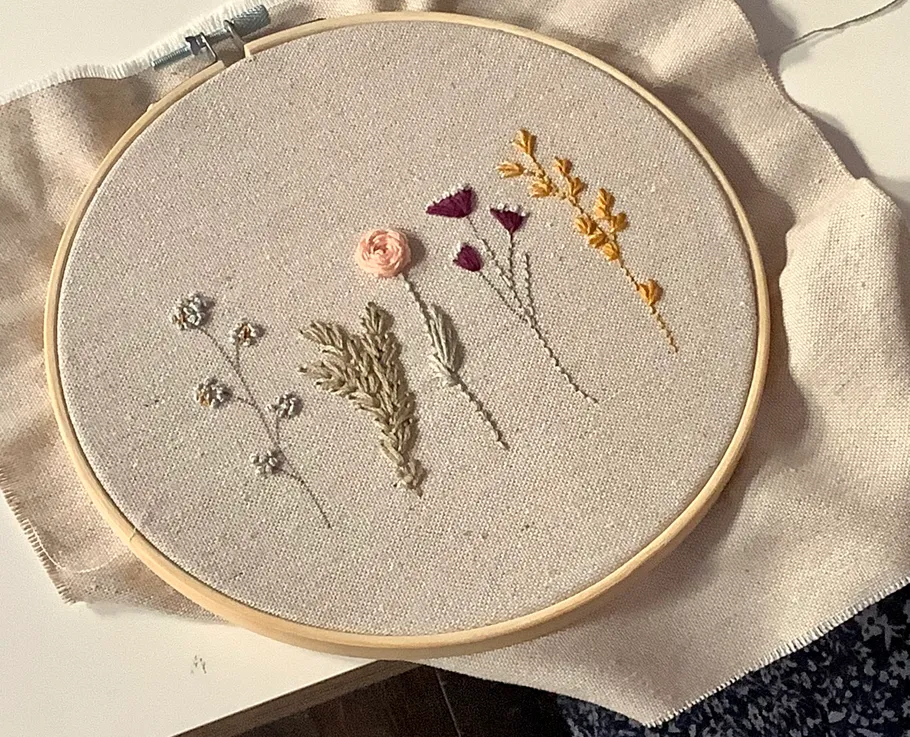
- Embroidering flowers and leaves: Great for practicing the running stitch or lazy daisy stitch.

- Embroidering a word or name: Easy to do with the backstitch.

- Embroidering geometric shapes: circles, triangles, lines.
- Embroidering suns, clouds & rainbows: minimalist or playful, whatever you like.
- Embroidering plants and herbs: like lavender, eucalyptus, or a little cactus
- Embroidering your zodiac sign: A great beginner project, personal, simple, and beautiful. Use the backstitch for the lines and the French knot for the stars. That's all you need!