
- Learning to Sing as a Beginner: Anyone can learn to sing, even without natural talent
- Top Five Tips for Learning to Sing: Keep your jaw relaxed, pay attention to your posture, drink plenty of water, be curious about your voice, and have fun.
- Visit me at Vocal Coaching in Berlin.
Singing is a skill that anyone can learn. In this article, you will find helpful tips on learning to sing, how to use your voice correctly, and what you should look out for when singing.
How do I train my voice?
Vocal training is not conventional "strength training." The big challenge for many is letting go of the urge to "want to sing well."
When you "push" the voice in a certain direction, it not only makes singing exhausting but also affects the quality of the voice.
Very often, there is a tendency at the beginning to use too much power and "push out" the voice. To let go of this tendency, it is important to experience that there is another way. By letting go, singing becomes more natural and, at the same time, more powerful. So, when practicing singing, be open-minded, experimental, and kindly curious about what your voice gives of its own accord without you pushing it out.
There are many preconceived notions about what a "good voice" should sound like or who has talent and who doesn't. Unfortunately, this only creates fear of not being vocally sufficient. Fear blocks the voice. In my workshop, I will show you how to use your voice in a healthy and effective way.

Can you learn to sing without talent?
Anyone who can speak can also learn to sing.
When we explore our full voice, discovering the natural volume and the entire vocal range, we realize that we probably have much more talent than we initially thought. To get away from the judgmental "talent" or "no talent" mindset, I like to teach the voice as an instrument: Seeing yourself as an instrument that you assemble and learn to play makes the craft aspect of singing clear and tangible for everyone. If the instrument cannot sound full because of, for example, unfavorable posture or a tense jaw, you might think you are not talented. In reality, however, it is often just the airflow that cannot flow freely because of the posture and jaw tension, which may result in issues with intonation or not being able to hold notes as long as you would like.
When we view ourselves as an instrument, we effectively move away from the black-and-white thinking of being talented or not talented. So many people have stopped singing far too early because of this distinction, and that is incredibly unfortunate.
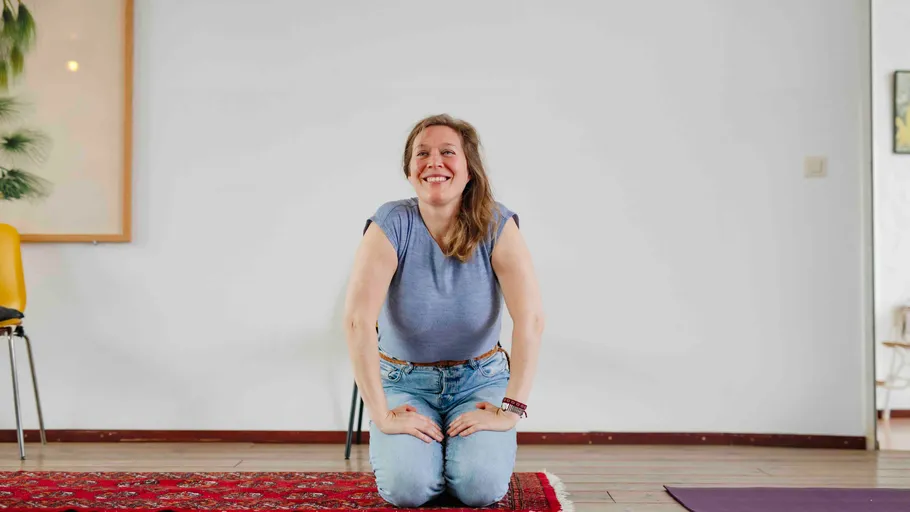
Top 5 tips for learning to sing for beginners
Here are the top 5 tips to help you learn to sing better:
1. Be curious about your voice:
Don't try to sound like others, whether it's voices on the radio or your friends. Each of us has a unique voice. If we dare to use this voice when singing, we are always authentic.
2. Pay attention to your posture:
Feel the contact of your feet with the ground. A helpful technique to ensure you are well-grounded is to designate one leg as your standing leg while the other leg remains weightless. This approach ensures that you find a firm grounding and a deep center of gravity: if the standing leg were to give way, you would lose your balance. From the grounded standing leg, imagine your body rising into an upright posture, as if you were being pulled up by an invisible thread at the back of your head. This posture combines stability with alignment and is crucial for allowing an unobstructed airflow while singing.
3. Keep your jaw relaxed:
Whenever you can – especially with long vowels – let your jaw drop completely vertically; this allows the airflow at the back of the throat to flow freely into the upper resonators. In this way, you can sing longer phrases and more volume develops naturally.
4. Drink plenty of water:
Since breathing is deeper when singing, we lose more fluid when exhaling. It is important to drink enough during and after singing.
5. Let go of the idea that singing only happens in the throat: Learning to sing is not just a laryngeal matter:
It is a matter of the whole body. In my workshop, I will explain how you can use your body as an instrument.

Can you learn to sing as an adult?
Learning to sing as an adult is absolutely doable. Most people who are considered "talented" singers from a young age often picked up this skill unconsciously at home. If singing is part of the environment, the musical ear is trained early on. But above all, it is practice. The coordination between ear and voice can be trained, so you can learn to sing later in life as well. It just takes a little patience. Singing is incredibly good for us. It is something that everyone should really do, regardless of how it sounds. Being able to convey your feelings through melodies is an enrichment for everyone.

How do you breathe when singing?
Breathing when singing is ideally significantly deeper than when speaking. In the workshop, I explain the breathing process, but I tell the participants not to focus too much on it to avoid them thinking obsessively only about their breath. Instead, I make sure that we activate and integrate this deep breathing through playful bodywork. The various exercises we do together in the group are all based on activating the deep breath.