- Craft over industry: craft beer is brewed by hand in small breweries and favors creativity over mass production.
- Special ingredients: beyond water, malt, hops, and yeast, special ingredients like fruit, spices, or exotic yeasts are often used.
- Flavor variety: craft beer can be sweet, sour, fruity, spicy, or even smoky, breaking away from traditional beer styles.
- Often a bit pricier: because of the involved, small-batch production process, craft beer is generally more expensive than conventional beer.
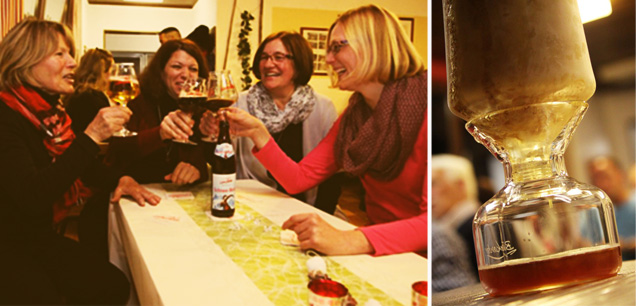
- Join a beer tasting in Lahnstein and sample different craft beers.
What Is Craft Beer?
Craft beer refers to beers that aren't produced industrially, but brewed by hand using traditional craftsmanship. Craft beer often uses ingredients that don't fit within Germany's traditional Beer Purity Law, meaning ingredients beyond just water, malt, hops, and yeast.
There's no legal definition of the term "craft beer" in classic beer countries like Germany, Belgium, England, and the Czech Republic, and there isn't one in the craft beer movement's home country, the US, either.
Myths and legends surround the term "beer" in general, and "craft beer" in particular.
A definition of craft beer does exist, though. If you look at the history of craft beer, it's actually quite clear-cut and unfolded as follows:
Craft Beer – A Historical Definition:
- Since the start of Prohibition, the US had been a country of uniform light and standardized beers.
- On October 14, 1978, then-President Jimmy Carter signed the law "H.R. 1337," legalizing homebrewing, which had previously been banned, as well as the founding of small breweries. These were initially called "microbreweries."
- Out of this situation, many people began brewing their own beer by hand at home. Long-forgotten ingredients like aroma hops, specialty malts, special yeasts, spices, fruits, and more came into play. The resulting unfiltered beers opened up entirely new flavor worlds.
- Today, some of these homebrewers have grown into world-famous breweries, and a global trend has emerged: rediscovering the individuality and diversity that a handcrafted beer can offer.
- Countless breweries around the world have joined, and continue to join, this movement, brewing craft beer.
- Craft beer became the brewing world's translation of the broader trend toward individuality and diversity.
- In the US alone, the number of breweries rose from 92 in 1980 to around 10,000 in 2024.
Craft beer is the return of individuality to the brewing industry.
The term "craft beer," by the way, first appeared in a 1982 publication by journalist Vince Cottone.

What Sets Craft Beer Apart from Regular Beer?
Craft beer differs from conventional beer in several ways:
Craft Beer | Regular Beer | |
|---|---|---|
Brewing Process | Usually handcrafted by small breweries. Creative recipes are used. | Usually mass-produced. The focus is on consistent flavor and efficiency. |
Ingredients | Alongside conventional beer ingredients, unusual or seasonal ingredients like different hop varieties, spices, or fruit are also used. | Follows a standardized recipe. |
Alcohol Content | Every variation: from alcohol-free to a strength comparable to spirits. | Usually ranges between 4.8 and 5.4 percent. |
Flavor | Anything is possible: from crisp to smooth, boldly sweet to sour or bitter, fruity or rusty, smoky or spicy. | Stays within the familiar flavor range. |
Philosophy | Craft brewers are often independent breweries who see themselves as part of a movement redefining beer culture. | Large breweries produce for the mass market, with economic efficiency as the main goal. |
Think of beer like French fries. Order fries from a fast-food chain, and you know you're getting a standardized product that looks and tastes the same in New York, Cairo, or Tokyo. But order homemade fries, and they'll look different every time, fried in different oils, made from different types of potatoes, and seasoned with different spices.
The same is true for the beers of the world. Order one of the well-known beer brands, and you know you're getting a standardized product.
Order a craft beer anywhere in the world, though, and you'll find every color imaginable, from pale straw yellow to deep black. Craft beer can be crystal clear or hazy, as crisp as champagne or as mild as lightly carbonated water, boldly sweet to sour or bitter, fruity or rusty, smoky or spicy. Some craft beers are alcohol-free, while others are as strong as spirits.

Craft Beer Ingredients
Craft brewers achieve this range of flavors and appearances by skipping the standard pale pilsner malt. Instead, they use one of the many specialty malts available. Similarly, craft beer usually isn't brewed with the standard bittering hop. There are around 300 hop varieties used in brewing. Craft beer doesn't have to use the standard lager yeast either, it might be a Belgian yeast, a champagne yeast, a wheat beer yeast, or something else entirely.

What Does Craft Beer Taste Like?
The variety of malts, hop types, and yeasts creates an almost endless range of flavors. Add in raw ingredients like fruit, spices, honey, chocolate, coffee, and more, and you can experience virtually any imaginable flavor in a beer. In other words: craft beer exists specifically to taste different from the standard beer you'd find at the supermarket. Whether craft beer is for you is something only you can find out, for example, by trying a beer tasting.

Why Is Craft Beer Often More Expensive?
Since craft beers aren't produced industrially but rather brewed by hand in smaller batches using special ingredients, craft beer is generally more expensive than industrially produced beer. Large-scale producers save money by streamlining processes, standardizing ingredients, and producing in bulk.
Products made industrially in large quantities from standardized ingredients are always noticeably cheaper than handcrafted products made in small batches from special ingredients. In that sense, craft beer is no different from other goods.
Which Beer Styles Count as Craft Beer?
Whether a beer counts as craft beer depends on two factors:
- Does the beer style originate from the craft beer era, or is it a classic style?
- Was the beer brewed by hand or industrially?
If a beer emerged during the craft beer era and was brewed by hand, it counts as craft beer.
Is Pale Ale a Craft Beer?
Whether a Pale Ale counts as craft beer depends on those same two factors.
If a large brewery produces a Pale Ale industrially in bulk, it doesn't count as craft beer.
If the Pale Ale is brewed by a small, handcrafting brewery, it is craft beer.
The same logic applies to India Pale Ale. Would you consider a classic English India Pale Ale, the kind you could have enjoyed in large quantities 200 years ago, to be craft beer? The "descendants" of this classic are a different story: American-style IPAs, hazy IPAs, double IPAs, and many more definitely only emerged during the craft beer era, starting in 1978. Their production is usually handcrafted, using special ingredients. These beers can be considered craft beer.
Is IPA a Craft Beer?
The same conditions apply to India Pale Ale (IPA). A classic English India Pale Ale, brewed in large quantities for the past 200 years, isn't considered craft beer. But the descendants of this classic are a different matter: American-style IPAs, hazy IPAs, double IPAs, and many more only emerged during the craft beer era (since 1978). These beers are usually handcrafted using select ingredients and can therefore be interpreted as craft beer.

What Market Share Does Craft Beer Have in Germany?
There are no official figures on craft beer's market share in Germany, due to the lack of a clear definition. That said, some numbers can help give you a sense of scale. As of 2023, there were 1,184 breweries in Germany producing less than 10,000 hectoliters (about 264,000 gallons) annually. Given these low production volumes, it's fair to say these breweries mostly brew by hand. Add to that around 11,000 hobby brewers, who brew exclusively by hand (Süddeutsche Zeitung, 2023). Together, these two groups brewed around 1.6 million hectoliters of beer in 2023, making up 1.8% of Germany's total beer production (Deutscher Brauer-Bund e.V., n.d.). So craft beer in Germany remains a niche. But then again, aren't all handcrafted products niche products in some sense?