Acro Yoga – Key Takeaways
- Acro Yoga combines acrobatics with partner exercises and community-based trust.
- Emerging around the turn of the millennium, two approaches from Canada and the US shaped today's practice.
- Basic Acro Yoga poses: Front Bird, Back Bird, Throne, and more.
- Acro Yoga offers a great mix of fun, community, and physical challenge.
- If you'd like yoga elements in your Acro Yoga practice, try Gravity Yoga in Hamburg.
What Is Acro Yoga?
Acro yoga is a blend of acrobatics and gentle movement forms that emerged around the turn of the millennium through two different approaches (and possibly independently of each other).

The Origins of Acro Yoga and Its First Quarter Century
AcroYoga Montreal
Around 1999, Jesse Goldberg and Eugene Poku developed a form of lifting figures in Canada, inspired by dance and contact improvisation. This version focused on flowing movement and community. Initially called "ContactAcro," the practice evolved over time to align with the prevailing image of yoga, leading in 2003 to both the founding of "AcroYoga Montreal" and the renaming of the practice to "AcroYoga."
AcroYoga International
A bit later in the US, Jason Nemer, together with Jenny Sauer-Klein, combined acrobatic lifting figures with Thai massage and "Therapeutic Flying," founding "AcroYoga International" ("AcroYoga Intl.") in Los Angeles, California, in 2003. Because of Jason's strong acrobatic background, this version was more dynamic and acrobatics-focused than the Canadian one. To balance out this powerful practice, which he also called "Solar" in keeping with terminology popular in yoga circles at the time, he combined it with the two gentler practices mentioned above, initially grouping them under the term "Lunar" as roughly equal counterparts.
Around 2006, Jason Nemer attempted to trademark "AcroYoga." He lost that legal battle. But it's largely thanks to his strong drive to bring his AcroYoga out into the world that Acro Yoga classes and communities exist all over the globe today. Out of that drive, Jason Nemer also pursued intensive marketing for AcroYoga and tirelessly trained Acro Yoga teachers.
The original form, AcroYoga Montreal, thankfully still exists today, and hopefully will for a long time to come. This Montreal community is especially warm and puts values front and center that I fully support myself. Here, people come first, the mission includes social justice, and the guiding philosophy emphasizes that the practice adapts to the body, not the other way around. Inclusion is a given. This framework isn't just stated as an introduction at the top of the About Us page, in my experience, it genuinely reflects the sincerely lived standards and principles of the AcroYoga Montreal community. Hats off to them.
In what follows, though, I'll focus on Jason Nemer's version of Acro Yoga, along with the many directions that have largely branched out from this form over the past two decades, given Jason's massive influence on spreading and popularizing AcroYoga through training, festivals, and social media.
Today, various styles write this name sometimes as "Acro Yoga," sometimes as "AcroYoga." I use the term "Acro Yoga" (with a space) to reflect the diversity of practices today. To me, "Acro Yoga" feels like the more open designation.
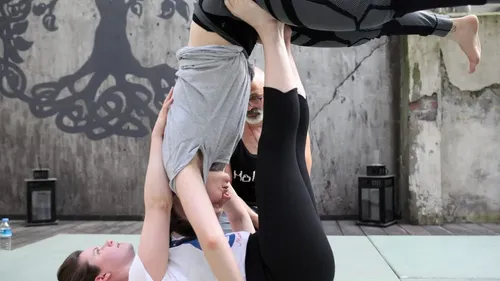
 Acro Yoga exercise: Throne - Joscha Ahlers, Anie Dahms, Amir Eid
What Is Acro Yoga Today?
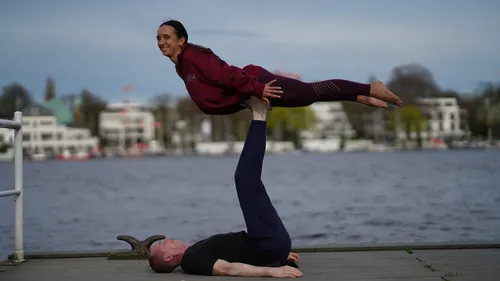
Today, Acro Yoga is a wonderful sport for pushing yourself to the limit together with others. Everything revolves around three roles:
- Base: the person supporting the flyer.
- Flyer: the person in the air, being carried by the base.
- Spotter: the person or people ensuring safety.
 Acro Yoga exercise: Back Bird with flyer Tankred Stuckensen, base Heiko Moses, and spotter Jelena Kovacevic
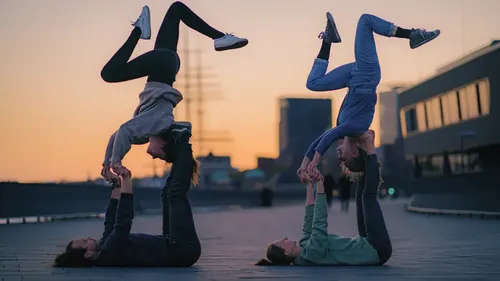
Acro Yoga is all about lifting and being lifted, overhead, sideways, on your back, high in the air, or hovering closer to the ground. Without the danger of getting hurt, because you can rely on the spotter. Trusting each other. That's Acro Yoga.
For many, this sport can feel unusual the first time. Most people have written "something like this" off in their lives, either as impossible, or as "maybe back when I was younger." But it's not that way at all. And there's real power in experiencing that firsthand, with disbelief and amazement.
What makes Acro Yoga special is that there's no competition here, the core idea of mutual support takes center stage instead. Acro Yoga has drawn very close to acrobatics, and especially partner acrobatics, today a love story that didn't start out that way and had more than a few growing pains (a story for another time). There's now a lively exchange between these disciplines. The gentle, quiet "Lunar" elements have effectively disappeared from practice, though they're still kept alive at the occasional festival and in training programs that stay true to tradition.
If you find good Acro Yoga instruction, with all the rigor and respect the exercises deserve, you should still feel welcomed as a beginner in a way that leaves you feeling safe and, in the best sense, empowered. A comment from a participant about ten years ago isn't an isolated case, it's been echoed in similar words many times since, but she put it especially beautifully: "I wouldn't have needed a car to get home. I was still flying." Courage, trust, and self-confidence help, and if they're already there, this practice awakens and builds on them. Acro Yoga is simply a wonderful practice.
That wonderful quality can get lost if you see Acro Yoga too much as a way to prove to yourself that you can do this or that move. Then most of the fun is gone. But good instruction can catch that too, and guide you back toward what actually helps you in the long run.
The joy of Acro Yoga, and there's an incredible amount of it in this practice, depends heavily on the guidance you get and your own willingness to embrace the unexpected.
May your Acro Yoga journey begin!
Creative ideas delivered to your inboxSign up for the newsletter now and get creative, mindful events near you by email.


What's the Difference Between Acro Yoga and Yoga?
You might be thinking: sounds cool, but that's not yoga!
Yes, that's correct, it's not. If you're looking for yoga, a pure Acro Yoga class today isn't the right fit. As the director of Center Of Gravity in Hamburg, this actually bothered me, since we opened the first Acro Yoga center in Europe back in 2016. With that step, I held myself to a certain standard for the "legitimacy" of the name Acro Yoga, a standard that, on closer inspection, simply wasn't being met. Call me a nerd or a stickler, but for me, yoga needs to actually be in there if it says yoga on the label.
Out of that standard, something new eventually emerged: Gravity Yoga. In December 2024, we introduced a new form of yoga that's actually yoga, drawing on Acro Yoga, the central yoga texts, and foundational reflections on the statements made in them. It really turned into something special.
What Do You Need for Acro Yoga?
The great thing about Acro Yoga: you don't need any prior experience or a partner to get started.
What you should bring, and what you don't need:
- You'll benefit from Acro Yoga if you're open to embracing the unexpected and trying new things.
- It helps if you're willing to question your beliefs and let them shift in a positive direction, whether those are beliefs about your own abilities or someone else's.
- With good instruction, you don't need any special physical abilities. We like to say: there's no such thing as "too small," "too weak," "too stiff," "too old," and so on, and also no such thing as "too strong," "too flexible," or "too athletic."
Acro Yoga for Beginners: The Basic Poses
Acro Yoga consists of a wide variety of lifting figures that challenge you through new perspectives and the fundamental need to let go and trust. The best beginner exercises focus on the basic poses:
Basic Poses on the Stomach:
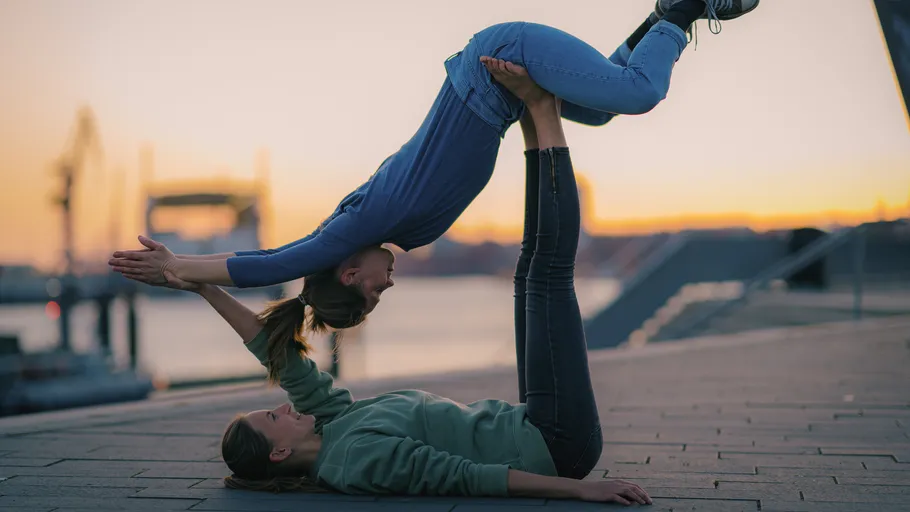
- Front Plank: The base lies on the ground, well grounded through the shoulders and sacrum, with strong, extended arms reaching toward the flyer. The flyer holds full body tension, hands connected to the base's hands. The arms stay relaxed, and the hand connection is gentle. The spotter stands stably beside the flyer, hands hovering about 2 inches from the flyer's pelvis, fingers pointing toward the hip bones. Once you're in position, it's relatively easy to hold. In our experience, though, getting into the position is often the tricky part and requires special attention. There are several valuable tips and tricks that can help here, but they go beyond the scope of this casual article format. I recommend everyone take classes under competent instruction to avoid injuries and property damage, minimize frustration, and set yourself up for success. That way, courage, trust, and the joy of practicing together successfully can take center stage.
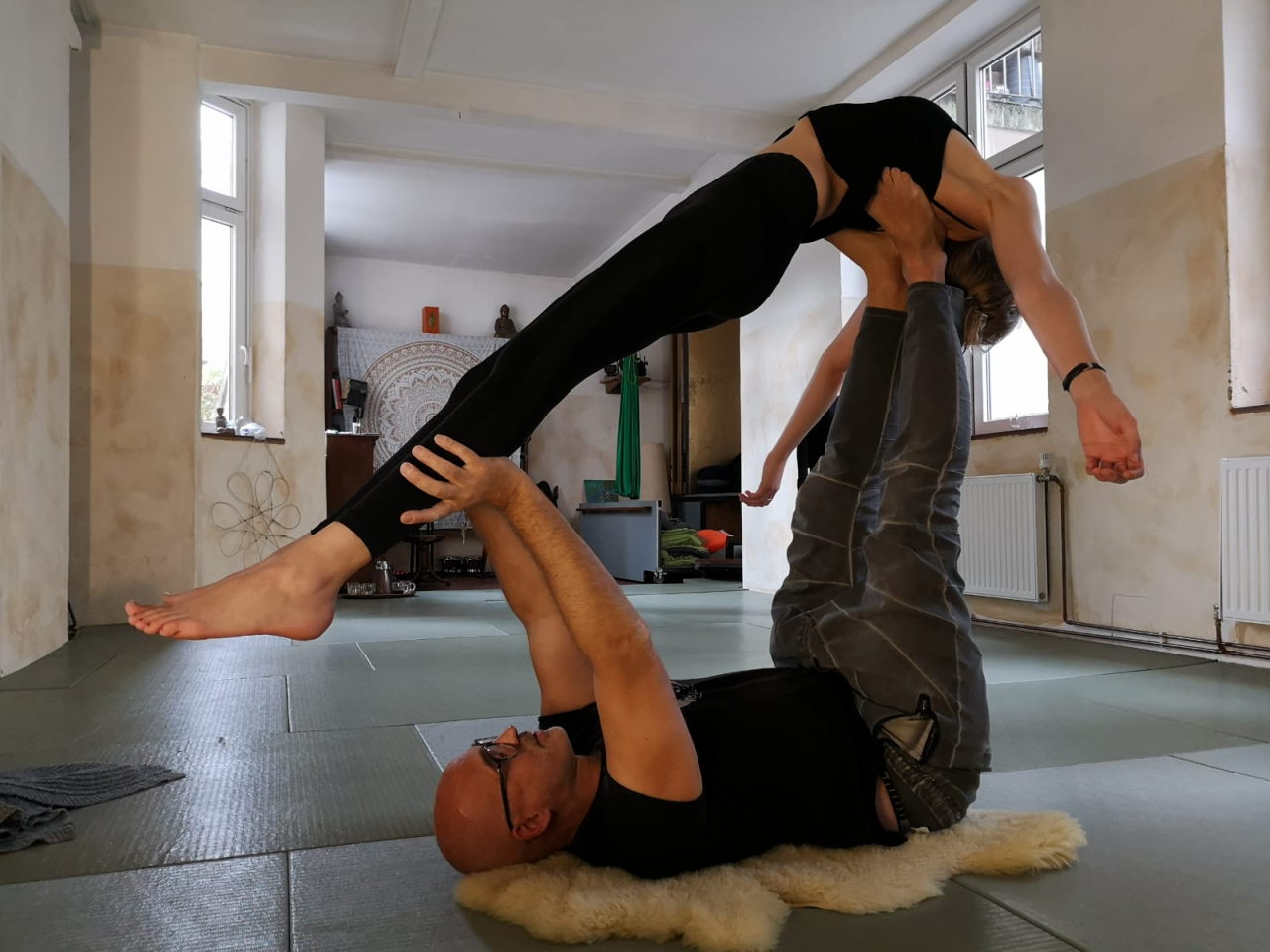
- Front Bird: The flyer releases their hands and moves their arms alongside the body, palms facing toward the feet, gaze forward. Otherwise, the same as Front Plank. Slightly adjusted spotting: the spotter's inner hand moves under the flyer's nearest shoulder. Slightly adjusted basing with a different foot and leg angle: the legs are pulled a bit closer to the body, and the feet point with the balls toward the sky (pointing).
- Front Bow: Please don't try this without instruction.
 Acro Yoga pose: Front Bird flyer - Anie Dahms, Sandra Wittek
Basic Poses on the Back:
- Back Bird: Please don't try this without instruction.
 Acro Yoga pose: Back Bird - Benedict Kraus, Anke Maurer, Janine Grawe, Heiko Moses
Upright Basic Poses:
- Throne: Please don't try this without instruction.
- Foot to Shin: Please don't try this without instruction.
 Acro Yoga pose: Reverse Throne - Janine Grawe
Overhead (Inverted) Basic Poses:
- Star: Please don't try this without instruction.
- Bat: Please don't try this without instruction.

Acro Yoga pose: Star - Anke Maurer, Ralph Buse, Jelena Kovacevic, Benedict Kraus, Heiko Moses, Tankred Stuckensen
With these Acro Yoga poses, you build the foundation for transitions, and then for more complex movement sequences, known as "flows." A special form of these are "washing machines," repeating sequences of two to four positions.
What Are the Benefits of Acro Yoga?
- Acro Yoga lets you reinvent yourself all over again. The power of the perspective shifts you're forced into is genuinely impressive.
- You'll become strong and flexible, not because that's your goal, but as a natural side effect, bit by bit.
- If you want, you'll become part of a strong, empathetic, and joyful community.
- Every exercise challenges you to expand your limits. In the end, you're left not just with the good feeling of having accomplished something new, but also with courage, trust, self-confidence, and likely a smile on your face.

Anja Roth, Bente Ploog
Acro Yoga - Conclusion
Acro Yoga is a fascinating sport that excites millions of people worldwide, from every walk of life. It combines acrobatics, teamwork, and fun like almost no other movement form.
Even though Acro Yoga isn't actually yoga, that doesn't bother most people who get into it, simply because it's so much fun. And if it does bother you, and you want to bring yoga into your practice, you can come to Gravity Yoga and enjoy the best of both worlds.
If you're curious, just try Acro Yoga! All you need is openness, curiosity, and a willingness to push your own limits. Afterward, you might just find yourself saying: "I wouldn't have needed a car to get home, I was still flying!"

Acro Yoga – FAQ
Discover classes of Center Of Gravity